
In Geer, a public consultation on a wind farm proposal became the first test of Portail Citoyens (Citizen Portal), an independent initiative exploring a straightforward idea: let residents ask their own questions of public documents. This first experiment points towards a different way of approaching civic participation.
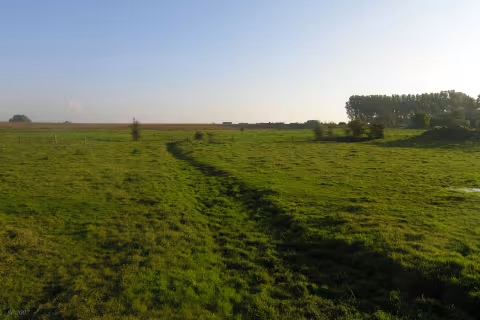
Lens-Saint-Servais, illustrative photograph taken in 2007. It does not show the proposed wind turbine locations. Photo: Flamenc / Wikimedia Commons, CC BY-SA 3.0. Original photograph, unmodified.

Imagine a resident of Lens-Saint-Servais. A wind farm is proposed near her home. She wants to know what the documents say about noise, birds and the position of the turbines. She simply wants to understand a project that might change her surroundings.
The documents are available. But where should she start? Studies, maps, appendices and technical terminology all take time to navigate and understand.
This resident is an illustration, not someone interviewed for the article. The difficulty is real: information does not automatically become accessible simply because it has been published online.
Seven wind turbines, and far more than seven questions
In the Hesbaye region of Belgium, the Geer–Ligney / Geer–Braives proposal involves seven wind turbines: five in Geer and two in Braives. According to developer HesbEnergie, they could reach a height of 200 metres. The proposed area lies between Lens-Saint-Remy, Lens-Saint-Servais and Tourinne, with associated infrastructure in Hannut.
The question is not simply which side to take. Developers highlight renewable electricity and cooperative ownership, while some nearby residents voice concerns. As Qu4tre's reporting shows, the debate is genuine and contested. CESE Wallonie has also issued an opinion on the project.
Between these positions lie practical questions. How far would a home be from a turbine? What does the environmental study say about wildlife? How might construction proceed? And what exactly does the file say on each point?
The public consultation ended on 5 November 2026. It was during this limited window that the first version of Portail Citoyens took shape.
What if we started with the question, rather than the file?
The aim was never to build yet another chatbot simply because AI was available. It arose from an everyday obstacle: asking a technical file a meaningful question often requires knowing how that file is organised in advance.
The prototype organised around twenty documents from the consultation into approximately 1,636 searchable passages. These figures describe the experimental collection, not the complete legally authoritative case file.
A visitor could ask, “What does the study say about noise at night?” and follow up with, “What about the nearest homes?” The tool searched for relevant passages and offered references to inspect.
That may sound like a small change. For someone unfamiliar with acoustic studies, or who struggles to read long technical documents on screen, it matters. Instead of requiring people to speak the language of the file, the goal is to let them begin in their own words.
The prototype also offered assistance with drafting a personal observation. Visitors could review, edit and copy a draft, then send it themselves to the relevant authority while the consultation was open. The portal never submitted comments automatically. Copying a draft did not constitute a formal submission.
A starting point, not a machine that is always right
AI can help locate and explain passages, but it can also be wrong, miss nuance or connect pieces of information incorrectly. Those limits matter particularly where environmental, legal and technical questions meet strongly held views.
The assistant's role is closer to that of a patient librarian than an expert delivering a verdict: point people towards sources, help them explore and leave verification to the reader. Original documents and official procedures remain authoritative.
Portail Citoyens does not decide whether the turbines should be built. It does not replace the public administration, technical studies or public debate. Its purpose is to make participation less dependent on spare time, digital confidence or familiarity with administrative language.
Accessibility calls for understandable explanations, clear navigation and attention to people less at ease with digital tools. That is work still to be done, not a quality any prototype can claim by default.
After the wind farm consultation, the real question begins
The Geer–Ligney consultation is over. The problem that inspired the portal has not disappeared.
In future, the same approach could help people explore planning applications, municipal decisions or public budgets. The aim would not be to manufacture opinions, but to help people form their own from verifiable information.
These are possibilities, not services already available. Delivering them will require careful work on document reliability and provenance, publication rights, privacy, usability and honest communication about the tool's limitations.
There is a deeper question too: how can public consultation avoid favouring those who already have the time, knowledge and confidence to engage? Technology will not remove that inequality on its own, but it may help reduce it.
This independent initiative was started by Jonathan Maerckaert, a resident of Geer, municipal councillor and director of E-merging Digital SRL. The portal is neither an official municipal service nor a project commissioned by the municipality. The experiment shows how document search, web development and AI become meaningful when applied to a specific human need.
The wind farm consultation provided the first real-world test. The ambition is broader: one day, when faced with a complex public file, people might move from “I don't understand any of this” to “Here is what I would like to know”.
Follow the initiative's next steps at portailcitoyens.be. The question-answering and observation-drafting service is temporarily unavailable while the portal is being developed further.